
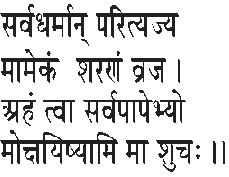
Abandon all dharmas and take refuge in Me alone. I will deliver thee from all sin and evil, do not grieve.
The Core of the Gita's Meaning
Part1 | Part 2
Part 1
What then is the message of the Gita and what its working value, its spiritual utility to the human mind of the present day after the long ages that have elapsed since it was written and the great subsequent transformations of thought and experience? The human mind moves always forward, alters its viewpoint and enlarges its thought substance, and the effect of these changes is to render past systems of thinking obsolete or, when they are preserved, to extend, to modify and subtly or visibly to alter their value. The vitality of an ancient doctrine consists in the extent to which it naturally lends itself to such a treatment; for that means that whatever may have been the limitations or the obsolescences of the form of its thought, the truth of substance, the truth of living vision and experience on which its system was built is still sound and retains a permanent validity and significance. The Gita is a book that has worn extraordinarily well and it is almost as fresh and still in its real substance quite as new, because always renewable in experience, as when it first appeared in or was written into the frame of the Mahabharata. It is still received in India as one of the great bodies of doctrine that most authoritatively govern religious thinking and its teaching acknowledged as of the highest value if not wholly accepted by almost all shades of religious belief and opinion. Its influence is not merely philosophic or academic but immediate and living, an influence both for thought and action, and its ideas are actually at work as a powerful shaping factor in the revival and renewal of a nation and a culture. It has even been said recently by a great voice that all we need of spiritual truth for the spiritual life is to be found in the Gita. It would be to encourage the superstition of the book to take too literally that utterance. The truth of the spirit is infinite and cannot be circumscribed in that manner. Still it may be said that most of the main clues are there and that after all the later developments of spiritual experience and discovery we can still return to it for a large inspiration and guidance. Outside India too it is universally acknowledged as one of the world's great scriptures, although in Europe its thought is better understood than its secret of spiritual practice. What is it then that gives this vitality to the thought and the truth of the Gita?
The
central interest of the Gita's philosophy and Yoga is its attempt, the
idea with which it sets out, continues and closes, to reconcile and even
effect a kind of unity between the inner spiritual truth in its most absolute
and integral realisation and the outer actualities of man's life and action.
A compromise between the two is common enough, but that can never be a
final and satisfactory solution. An ethical rendering of spirituality
is also common and has its value as a law of conduct; but that is a mental
solution which does not amount to a complete practical reconciliation
of the whole truth of spirit with the whole truth of life and it raises
as many problems as it solves. One of these is indeed the starting-point
of the Gita; it sets out with an ethical problem raised by a conflict
in which we have on one side the dharma of the man of action, a prince
and warrior and leader of men, the protagonist of a great crisis, of a
struggle on the physical plane, the plane of actual life, between the
powers of right and justice and the powers of wrong and injustice, the
demand of the destiny of the race upon him that he shall resist and give
battle and establish even though through a terrible physical struggle
and a giant slaughter a new era and reign of truth and right and justice,
and on the other side the ethical sense which condemns the means and the
action as a sin, recoils from the price of individual suffering and social
strife, unsettling and disturbance and regards abstention from violence
and battle as the only way and the one right moral attitude. A spiritualised
ethics insists on Ahinsa, on non-injuring and non-killing as the highest
law of spiritual conduct.
The battle, if it is to be fought out at all, must be fought on the spiritual
plane and by some kind of non-resistance or refusal of participation or
only by soul resistance, and if this does not succeed on the external
plane, if the force of injustice conquers, the individual will still have
preserved his virtue and vindicated by his example the highest ideal.
On the other hand a more insistent extreme of the inner spiritual direction,
passing beyond this struggle between social duty and an absolutist ethical
ideal, is apt to take the ascetic turn and to point away from life and
all its aims and standards of action towards another and celestial or
supracosmic state in which alone beyond the perplexed vanity and illusion
of man's birth and life and death there can be a pure spiritual existence.
The Gita rejects none of these things in their place,—for it insists on
the performance of the social duty, the following of the dharma for the
man who has to take his share in the common action, accepts Ahinsa as
part of the highest spiritual-ethical ideal and recognises the ascetic
renunciation as a way of spiritual salvation. And yet it goes boldly beyond
all these conflicting positions; greatly daring, it justifies all life
to the spirit as a significant manifestation of the one Divine Being and
asserts the compatibility of a complete human action and a complete spiritual
life lived in union with the Infinite, consonant with the highest Self,
expressive of the perfect Godhead.
All the problems of human life arise from the complexity of our existence, the obscurity of its essential principle and the secrecy of the inmost power that makes out its determinations and governs its purpose and its processes. If our existence were of one piece, solely material-vital or solely mental or solely spiritual, or even if the others were entirely or mainly involved in one of these or were quite latent in our subconscient or our superconscient parts, there would be nothing to perplex us; the material and vital law would be imperative or the mental would be clear to its own pure and unobstructed principle or the spiritual self-existent and self-sufficient to spirit. The animals are aware of no problems; a mental god in a world of pure mentality would admit none or would solve them all by the purity of a mental rule or the satisfaction of a rational harmony; a pure spirit would be above them and self-content in the infinite. But the existence of man is a triple web, a thing mysteriously physical-vital, mental and spiritual at once, and he knows not what are the true relations of these things, which the real reality of his life and his nature, whither the attraction of his destiny and where the sphere of his perfection.
Matter and life are his actual basis, the thing from which he starts and on which he stands and whose requirement and law he has to satisfy if he would exist at all on earth and in the body. The material and vital law is a rule of survival, of struggle, of desire and possession, of self-assertion and the satisfaction of the body, the life and the ego. All the intellectual reasoning in the world, all the ethical idealism and spiritual absolutism of which the higher faculties of man are capable cannot abolish the reality and claim of our vital and material base or prevent the race from following under the imperative compulsion of Nature its aims and the satisfaction of its necessities or from making its important problems a great and legitimate part of human destiny and human interest and endeavour. And the intelligence of man even, failing to find any sustenance in spiritual or ideal solutions that solve everything else but the pressing problems of our actual human life, often turns away from them to an exclusive acceptance of the vital and material existence and the reasoned or instinctive pursuit of its utmost possible efficiency, well-being and organised satisfaction. A gospel of the will to live or the will to power or of a rationalised vital and material perfection becomes the recognised dharma of the human race and all else is considered either a pretentious falsity or a quite subsidiary thing, a side issue of a minor and dependent consequence.
Matter and life however in spite of their insistence and great importance are not all that man is, nor can he wholly accept mind as nothing but a servant of the life and body admitted to certain pure enjoyments of its own as a sort of reward for its service or regard it as no more than an extension and flower of the vital urge, an ideal luxury contingent upon the satisfaction of the material life. The mind much more intimately than the body and the life is the man, and the mind as it develops insists more and more on making the body and the life an instrument—an indispensable instrument and yet a considerable obstacle, otherwise there would be no problem—for its own characteristic satisfactions and self-realisation. The mind of man is not only a vital and physical, but an intellectual, aesthetic, ethical, psychic, emotional and dynamic intelligence, and in the sphere of each of its tendencies its highest and strongest nature is to strain towards some absolute of them which the frame of life will not allow it to capture wholly and embody and make here entirely real. The mental absolute of our aspiration remains as a partly grasped shining or fiery ideal which the mind can make inwardly very present to itself, inwardly imperative on its effort, and can even effectuate partly, but not compel all the facts of life into its image. There is thus an absolute, a high imperative of intellectual truth and reason sought for by our intellectual being; there is an absolute, an imperative of right and conduct aimed at by the ethical conscience; there is an absolute, an imperative of love, sympathy, compassion, oneness yearned after by our emotional and psychic nature; there is an absolute, an imperative of delight and beauty quivered to by the aesthetic soul; there is an absolute, an imperative of inner self-mastery and control of life laboured after by the dynamic will; all these are there together and impinge upon the absolute, the imperative of possession and pleasure and safe embodied existence insisted on by the vital and physical mind. And the human intelligence, since it is not able to realise entirely any of these things, much less all of them together, erects in each sphere many standards and dharmas, standards of truth and reason, of right and conduct, of delight and beauty, of love, sympathy and oneness, of self-mastery and control, of self-preservation and possession and vital efficiency and pleasure, and tries to impose them on life. The absolute shining ideals stand far above and beyond our capacity and rare individuals approximate to them as best they can: the mass follow or profess to follow some less magnificent norm, some established possible and relative standard. Human life as a whole undergoes the attraction and yet rejects the ideal. Life resists in the strength of some obscure infinite of its own and wears down or breaks down any established mental and moral order. And this must be either because the two are quite different and disparate though meeting and interacting principles or because mind has not the clue to the whole reality of life. The clue must be sought in something greater, an unknown something above the mentality and morality of the human creature.
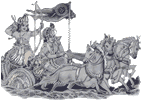
Sri Aurobindo
 About Us | ©1999 - 2009 searchforlight.org
All extracts and quotations from the written works of Sri Aurobindo and the Mother and the Photographs of
the Mother and Sri Aurobindo are copyright Sri Aurobindo Ashram Trust, Pondicherry -605002 India.